Fasteners
Backed-Out Screws and Dry Washers
Heat and cold work screws loose, and their rubber washers crack. Water then follows the screw shank into the building. We swap stripped screws for oversized ones and seal every head before coating.
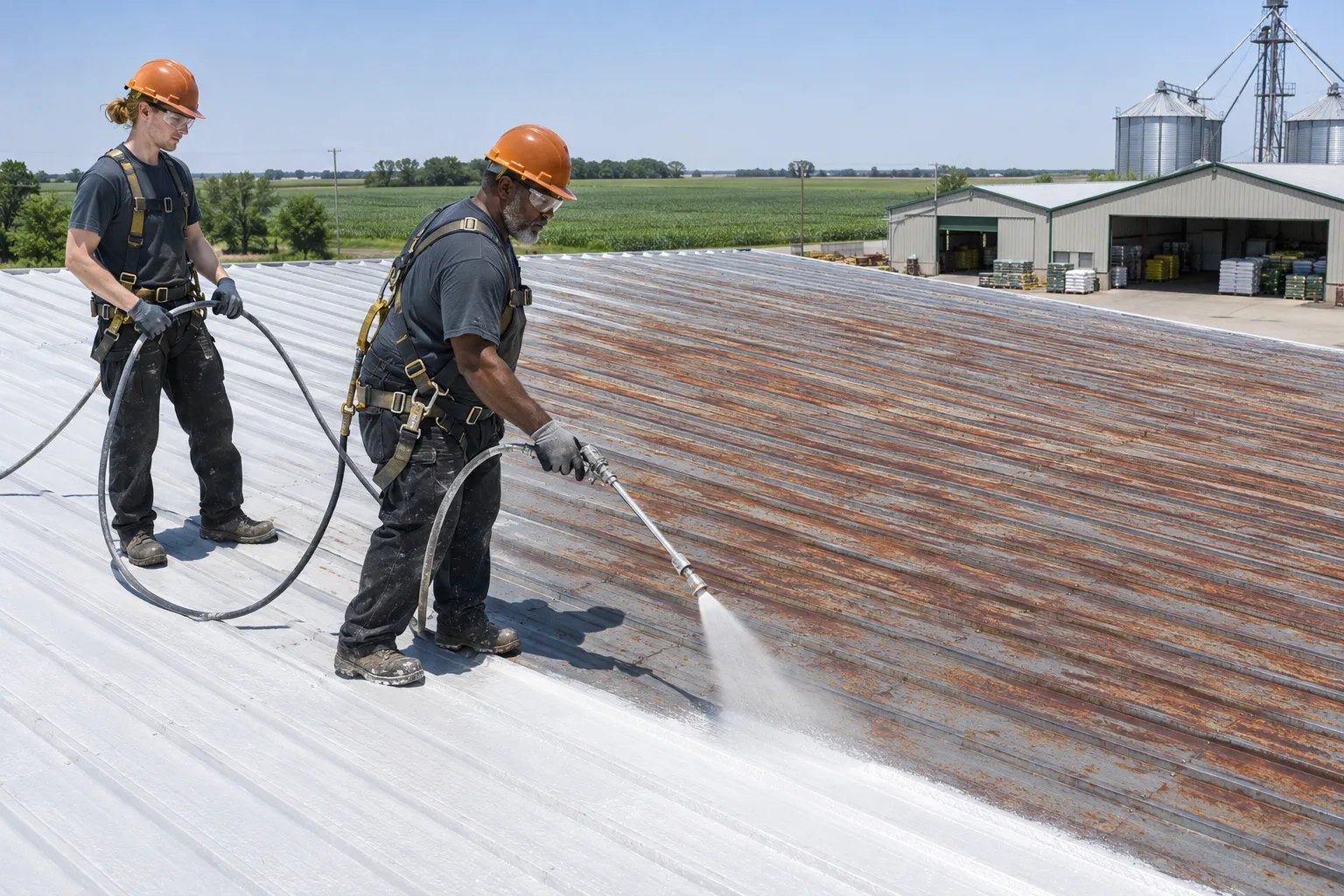
As a Hastings metal roof coating contractor, we clean, prime, and coat commercial metal roofs on warehouses, implement shops, and downtown buildings. Every job starts with a roof walk.
Roof Conditions
Most Hastings metal roof coating jobs start with one of these six conditions. Each one tells us what prep the panels need before the first coat goes on.
Heat and cold work screws loose, and their rubber washers crack. Water then follows the screw shank into the building. We swap stripped screws for oversized ones and seal every head before coating.
End laps on long panel runs pull apart as the steel moves. A thin line of rust along a lap is often the first sign. Fabric set in mastic closes the lap before the field coats.
Red rust that wipes off as powder sits on top of solid steel and takes primer well. Flaking scale is wire-brushed or washed off first, then a rust-inhibiting primer goes down.
Pinholes and soft panels along the eave cannot be bridged with coating. Those panels are replaced with matching metal, and the coats then cover old and new steel as one surface.
Rooftop units, exhaust fans, and skylight curbs break up the panel field, and the old sealant around them dries and splits. We strip it, reinforce each joint with fabric, and coat it with the roof.
Low-slope metal and flat additions can hold water for days after a storm. That spot decides the coating: silicone handles standing water, while acrylic belongs on panels that drain fast.
Process
Five steps take a worn metal roof to a coated one. Each step is checked before the next starts, so small problems get fixed while they are still small.
We walk every section, check screws, laps, curbs, and gutters, and look for wet insulation from inside. You get a plain list of repairs and the coating that fits.
Power-washing strips dirt, chalky paint, and loose rust. The roof dries completely before anything else goes on, because coating over trapped water fails early.
Rust gets primed, stripped screws are replaced with oversized ones, and rusted-through panels come out. Each fastener head is sealed with mastic or brush-grade coating.
Laps, ridge caps, curbs, and pipe boots get fabric set in a base coat. These details move the most, so they carry the extra layer.
Base and top coats go on at the thickness the coating maker lists, and wet film is measured as we go. A final walk checks coverage at every detail.
Benefits
A coating turns hundreds of laps and screw holes into one continuous surface. Here is what that changes on a Hastings metal building.
Seams, fastener lines, and the panel field are covered together, so water has no open joint to follow into the building.
A light coating reflects sunlight that dark, chalky steel soaks up, which cuts the heat moving through the roof into the space below.
The existing steel stays on the building. Work happens on top of the roof while shops, offices, and storage stay in use below.
Worn spots can be cleaned and touched up without opening the roof, and the whole surface can be recoated when the coating thins.
Tell us where the stain shows up inside and roughly how big the roof is. A ballpark estimate takes the roof size, and the inspection finds the source.
Services
We apply five coating systems. Each card lists what has to be true on the roof before that system goes on.
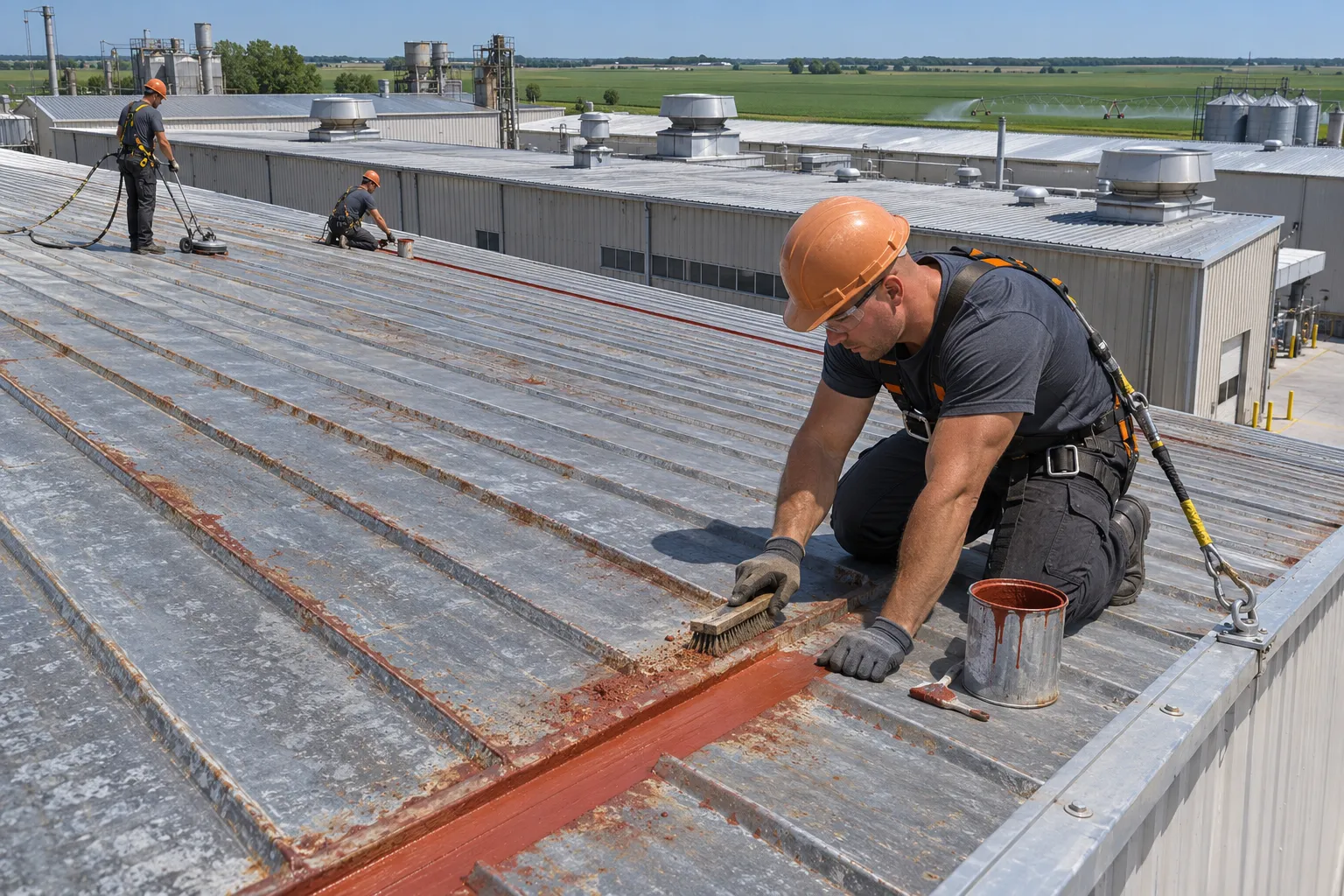
Primer, fastener sealing, and elastomeric coats for exposed-fastener and standing-seam steel on warehouses, co-op storage, and implement shops.
Ready To Coat When
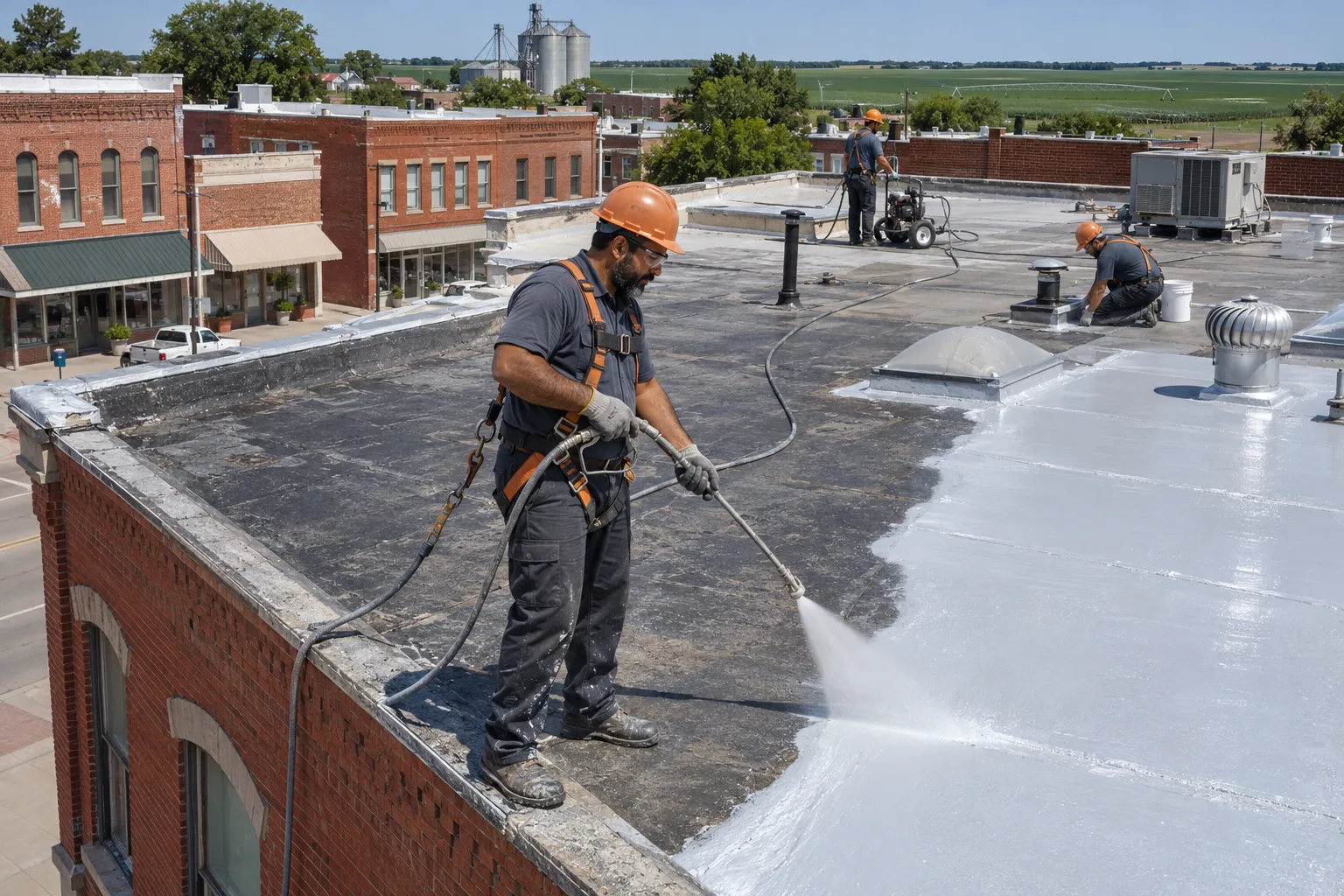
A moisture-cured coating for low-slope metal and flat additions where water sits after a storm and the roof sees little foot traffic.
Ready To Coat When
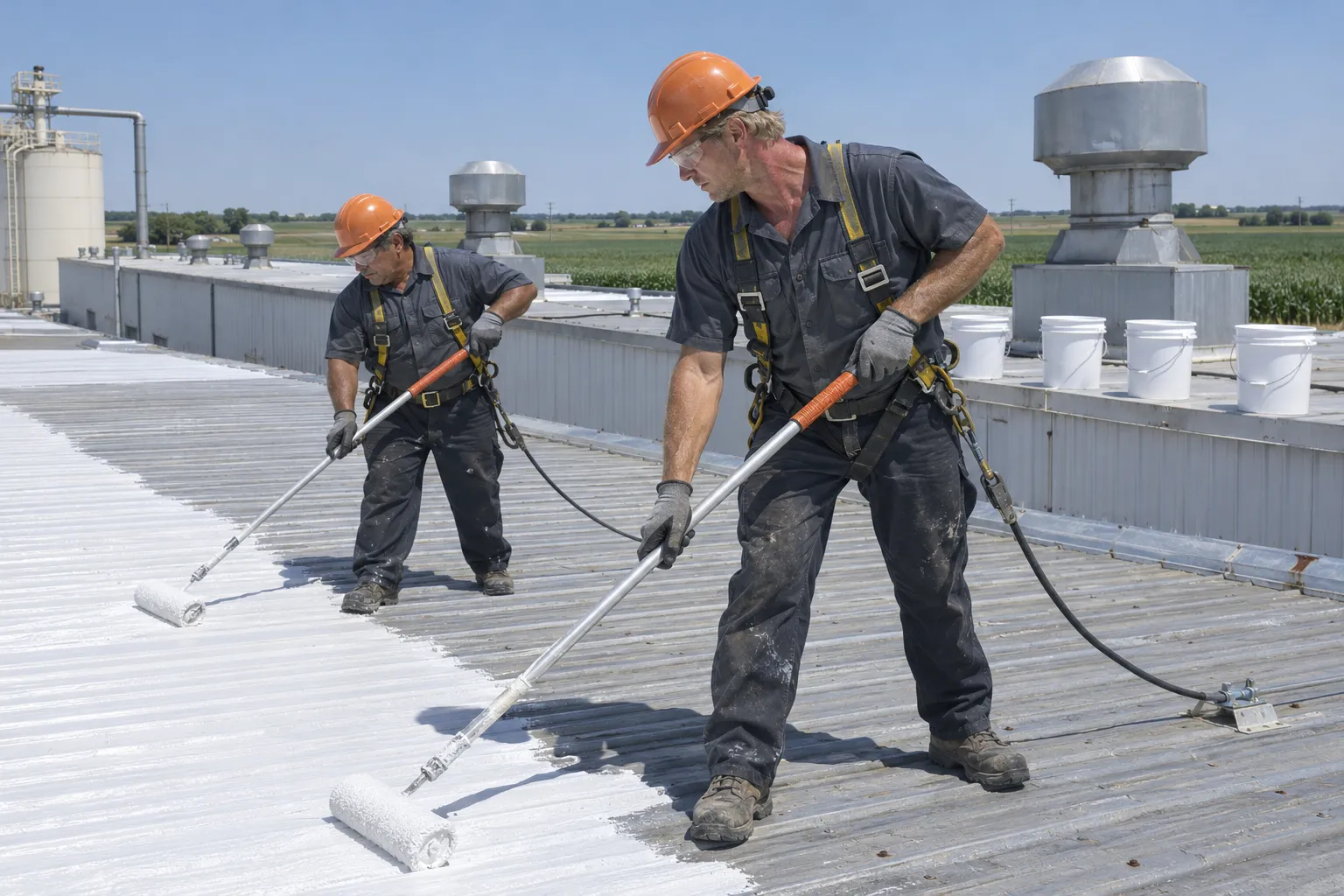
Water-based coats for sloped metal roofs that drain quickly, applied as a base coat and a contrasting top coat.
Ready To Coat When
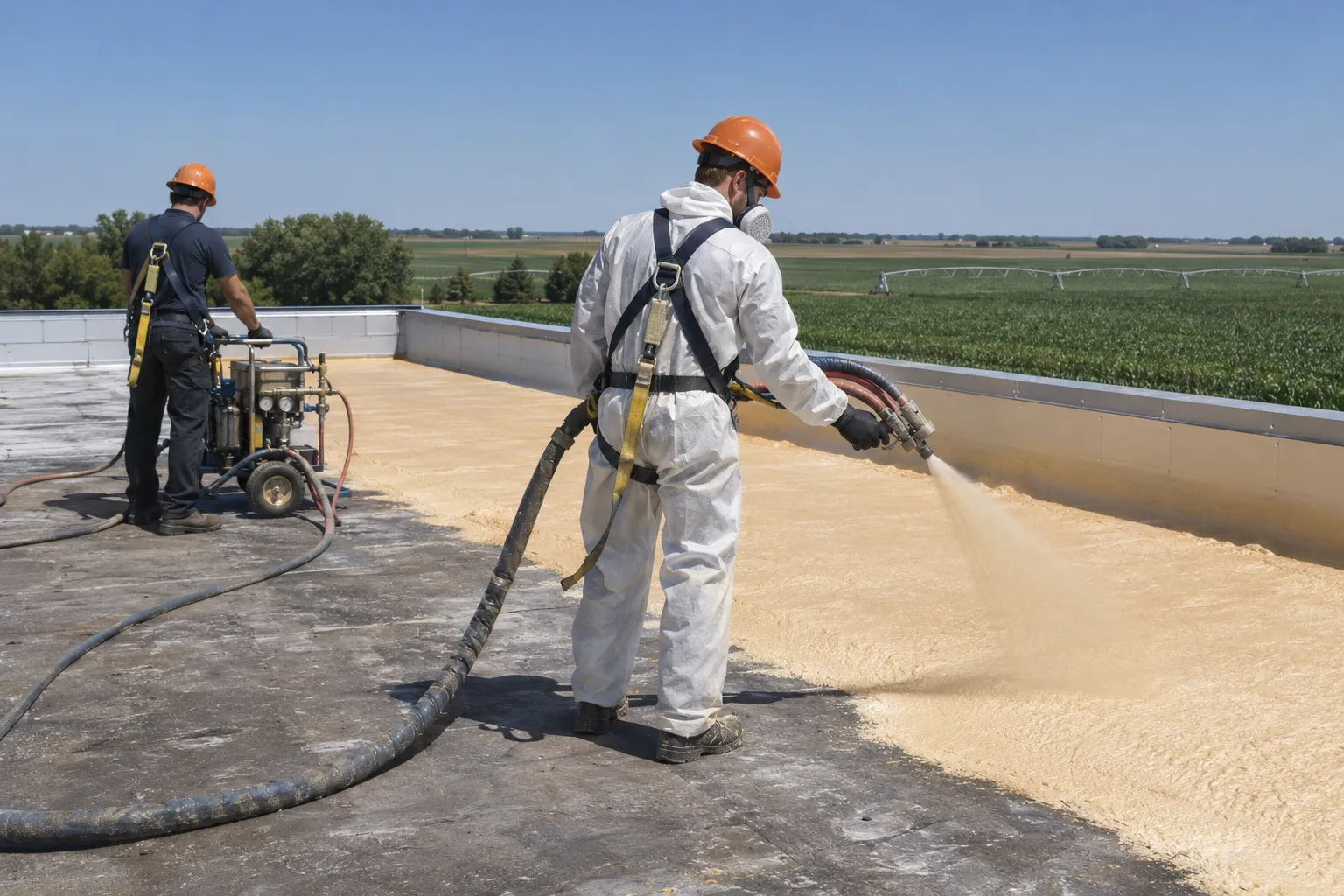
Sprayed polyurethane foam under a protective top coat, for roofs that need added insulation or a rebuilt slope toward drains.
Ready To Coat When
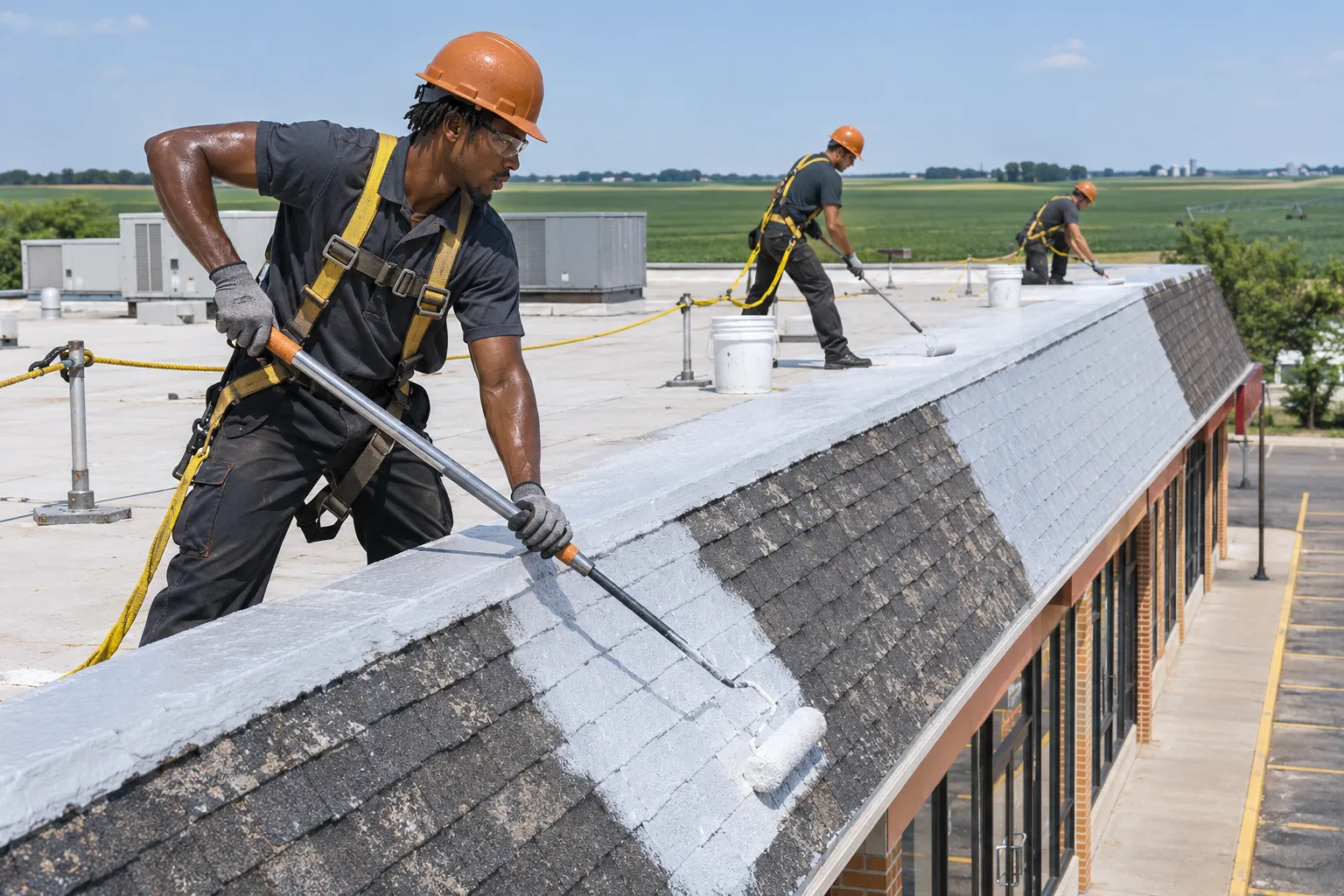
Coating for asphalt shingle roofs on offices, clinics, and churches, where the shingles still lie flat and hold their granules.
Ready To Coat When
Fit Check
Four roof situations we see often around Hastings, and the system each one starts with.
Most steel shops and storage buildings land here once rust is primed and screws are sealed.
Water that sits for two days or more points to a coating made for ponding.
Foam adds R-value and can be built up toward drains before its top coat.
When holes run through most panels, new metal comes before any coating.
Panel Replacement First
Service Area
Not sure your building is in our area? Call us or send us a message. We coat commercial metal roofs in Hastings, Superior, Elm Creek, Harvard, Red Cloud, and Kenesaw.
Warehouse and storage roofs here are coated section by section, so each run of panels gets its rust and screw work before the coats. Cost mostly follows how many panels can be saved.
Superior Metal Roof CoatingShop and storage roofs here are scheduled into spring and fall stretches when cure temperatures hold. Each coat is checked dry before the next one goes on.
Elm Creek Metal Roof CoatingAg buildings and shops here mostly carry exposed-fastener panels with rust at the end laps. Those laps and screws are sealed first, then the whole roof is coated.
Harvard Metal Roof CoatingStorefronts and offices here stay open while we work on top of the roof. Equipment is staged away from entrances, and overspray screens protect cars parked nearby.
Red Cloud Metal Roof CoatingBefore coating a roof here, we look for wet insulation, rust-through, and panels sagging over failed purlins. You learn which areas are ready and which need repair first.
Kenesaw Metal Roof CoatingFAQ
Straight answers to what Hastings building owners ask before a metal roof gets coated.
In most cases, yes. Rust sitting on solid steel is wire-brushed or washed off, then primed with a rust-inhibiting primer before coating. Panels with holes or soft spots are a different case. They are replaced with new metal first, because a coating cannot span open steel.
Often it is. Co-op warehouses and storage buildings around Hastings tend to have long, low-slope panel runs with exposed screws and few penetrations, and that layout coats efficiently. The framing and most panels need to be intact, so we check purlins, seam movement, and fastener backout first.
Plan on about $2.50 to $4.00 per square foot to coat a metal roof whose panels can be saved, against about $5 to $8 per square foot to replace it. Rust, seam and fastener condition, roof size, access, the number of coats, and any wet insulation decide where a building falls.
Prep work. Two roofs of the same size can land far apart once one needs hundreds of oversized screws, several new panels, or wet insulation pulled out. Access matters too: a building with an open lot and a low eave stages faster than one boxed in by traffic or tanks.
That comes down to thickness, chemistry, and care. Coating makers rate their systems by dry film thickness, and a thicker build earns a longer rating. Hail, ponding, sun, and foot traffic wear any coating, and a yearly walk with cleaning and spot repairs keeps it working longer before a full recoat.
It turns on the scope of the job. The City of Hastings has a separate Roofing Permit application, and Hastings Development Services decides whether a coating job needs one. We check with the city before starting, and always when panels or insulation are being replaced.
Send the roof size for a ballpark number, or call to set up a roof walk on your building.